Austin Real Estate Weekly Market Update – December 04, 2025
by: Dan Price, Broker at Team Price Real Estate
Austin's leading data analysis brokerage, where data drives exceptional service
Published on: Thursday, December 04, 2025 at 7:56 am
The Austin housing market continues to move deeper into a supply-driven environment as inventory rises faster than buyers are able to absorb it. Active listings across the Austin-Area MLS have increased 14.3% year over year, and Months of Inventory has climbed from 5.27 to 5.94—representing a 1.1× expansion in available supply and one of the most elevated levels seen in years.
With more homes competing for attention and turnover slowing, buyers are gaining leverage through longer marketing times and stronger negotiation power. Pricing remains relatively stable at the regional level, with average sold prices up slightly and median values edging down, reflecting a market supported by higher-end activity but softer demand in the middle tiers. The shift in leverage is clear: Austin is moving out of a rapid correction phase and into a normalization stage where realistic pricing, patient strategy, and data-driven expectations matter more than aggressive escalation.
Scroll down to view the full Austin Real Estate Market Statistics PDF for December 04, 2025.
Inventory Expansion and Market Rebalancing
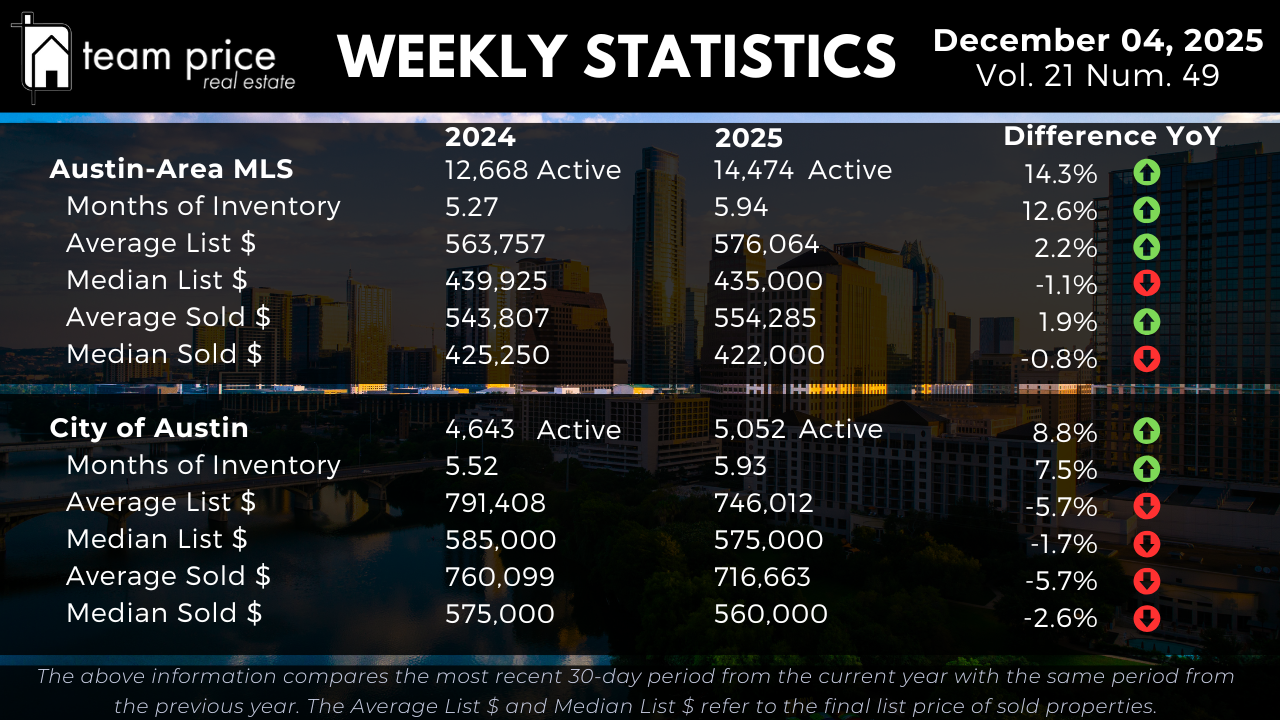
Inventory continues to expand across the Austin housing market as supply grows faster than buyer demand absorbs it. Active listings in the Austin-Area MLS rose from 12,668 last year to 14,474 today, a 14.3% increase. Months of Inventory climbed from 5.27 to 5.94, a 12.6% rise that represents a 1.1× expansion in available supply. This level of inventory places the region firmly in a supply-led environment, where homes take longer to attract offers and buyers have more leverage in negotiations.
Inside the City of Austin, inventory growth is more moderate but still meaningful. Active listings increased 8.8%, rising from 4,643 to 5,052. Months of Inventory moved from 5.52 to 5.93, a 7.5% increase that aligns closely with the metro-level trend. Both city and suburban markets are following the same trajectory: rising supply, slower turnover, and a gradual return to balance after an elongated correction cycle.
None of these changes appear temporary. The expansion of inventory reflects a structural shift toward normalization, where buyers benefit from more choice and more time. Sellers, in turn, must price with precision, present homes competitively, and avoid strategies based on momentum that no longer exists in today’s market.
Pricing Trends and Market Direction
Prices across the Austin-Area MLS remain stable, but the growth pattern has flattened compared with prior years. The average active list price increased modestly from $563,757 to $576,064, up 2.2% year over year. The median active list price declined from $439,925 to $435,000, a -1.1% shift that reflects a market leaning toward mid-range inventory rather than luxury-heavy listings. This subtle divergence between average and median prices points to a pricing environment that is holding steady rather than accelerating.
Sales data reinforces this picture of moderation. The average sold price increased from $543,807 to $554,285, a 1.9% year-over-year gain. The median sold price declined slightly from $425,250 to $422,000, down -0.8%. Inside the City of Austin, downward adjustments are more pronounced. The average active list price fell from $791,408 to $746,012, down -5.7% year over year, while the median active list price dipped -1.7% to $575,000. Sales followed the same pattern, with the average sold price dropping -5.7% to $716,663 and the median sold price declining -2.6% to $560,000.
Directionally, the pricing structure is stable but clearly not in an appreciation cycle. Buyers remain highly value-focused, and sellers who push prices above market alignment see extended days on market and deeper concessions. This is a discipline-first environment where strategy matters more than speed.
Negotiation Environment and Buyer Leverage
Negotiation patterns continue to favor buyers across the Austin-Area MLS. So far this month, 68.89% of all sold properties have closed below the list price, compared with 70.89% last month. Another 19.22% closed at list price, while 11.88% sold above list—up slightly from 10.92% last month and well above the 9.97% level seen in November 2024. Even with the small increase in over-ask closings, the larger trend remains clear: this is still a market where buyers dictate terms more often than sellers.
The average sold-to-list price ratio currently stands at 96.94%, confirming that sellers are conceding roughly 3% from list on average. While concessions remain consistent, they have stabilized, suggesting that sellers who price accurately can still secure clean offers. Mispriced listings, however, take longer to move and often require price reductions to realign with market expectations.
Precision is now the competitive edge. Buyers gain leverage through expanded selection and lower urgency, while sellers win when their list price reflects real comparables, not aspirational targets.
Regional & ZIP Code Performance
Market performance across Central Texas remains mixed but balanced. Month over month, 19 of 30 tracked cities (63%) reported price increases, while 11 (37%) posted declines. Year-over-year results show a similar distribution, with 14 cities (47%) gaining and 16 (53%) declining. Notably, none of the 30 cities remain above their 12-month peak; all 30 are below peak levels, confirming a full normalization cycle.
Across 75 ZIP codes, 41 (55%) posted month-over-month price increases, while 33 (44%) saw declines. Year over year, 39 ZIP codes (52%) are up and 36 (48%) are down—another sign of balanced market behavior rather than broad directional momentum. Only one ZIP code in Central Texas is above its 12-month peak, while 74 remain below, reflecting the same post-correction stability observed at the city level.
Market variance is now driven by hyperlocal factors: affordability, school district preference, product type, and neighborhood demand cycles. The broader regional trend is no longer declining—it is stabilizing.
Prices Relative to Peak Levels
Relative to peak conditions, the market has fully corrected and is now holding steady. In the Austin-Area MLS, the average sold price is 17.3% below its May 2022 peak, while the median sold price is down 21.9%. Price per square foot is 25–26% below peak levels, consistent with the broader correction observed over the past two years.
Inside the City of Austin, the pullback is similar. Median sold price is 17.3% below the May 2022 high, and the average sold price is down 15.7%. Price per square foot is down between 25% and 28%, depending on average vs. median. These declines are structural, not temporary. The correction is complete, and the market is now operating within a stable post-peak range.
Market Outlook
As we move into late 2025, the Austin housing market is transitioning into a steady and predictable phase after a multi-year correction. Supply continues to expand at double-digit rates, yet pricing remains stable, and appropriately calibrated listings still find buyers. Over-ask activity is rising slightly but remains limited to segments where inventory is tight and product alignment is strong.
The outlook is clear: buyers retain control over timing and negotiation, while sellers succeed through accuracy, readiness, and realistic pricing. Momentum is no longer the driving force—value justification is. Austin has shifted out of volatility and into a balanced, post-correction cycle that sets the stage for a more predictable 2026.
If this PDF does not display, click here to open in a new tab .
Austin Housing Market Questions and Answers
Are house prices in Austin falling?
Compared to the peak, yes. Compared to last year, prices are mostly flat to slightly down depending on the segment of the market you're looking at. Across the Austin-Area MLS, the average sold price increased from $543,807 to $554,285, a 1.9% rise year over year, while the median sold price declined from $425,250 to $422,000, a -0.8% decrease. This tells us that the typical home is selling for slightly less than last year, even though higher-end sales are keeping the averages elevated.
Inside the City of Austin, price movement is more clearly downward. The average sold price dropped from $760,099 to $716,663, a -5.7% decline, and the median sold price decreased from $575,000 to $560,000, down -2.6% year over year. Both the metro and the city remain well below their May 2022 peaks, with the Austin-Area MLS median sold price more than 20% below peak and the City of Austin median down around 17–18%. The most accurate description is that prices have already corrected sharply from peak and are now stabilizing in a sideways-to-slightly-down range rather than entering a new decline.
What is the real estate forecast for Austin in 2026?
The most realistic forecast for Austin in 2026 is continued normalization rather than a return to the rapid appreciation of prior years. Inventory has been rising faster than demand, with active listings in the Austin-Area MLS increasing 14.3% year over year and Months of Inventory moving from 5.27 to 5.94. The City of Austin shows the same pattern, with an 8.8% increase in active listings and Months of Inventory climbing from 5.52 to 5.93. These developments point toward a structurally looser market where buyers have more options and sellers must position competitively.
Prices have already reset from peak levels and are now holding mostly steady with mild softness. If mortgage rates remain elevated and inventory keeps expanding, 2026 is likely to feature a flat-to-soft pricing environment with additional downward pressure in segments where supply outweighs demand. If rates decline and job growth remains strong, conditions could stabilize further, but the likelihood of a sharp rebound back to 2022 pricing is low. Austin is transitioning into a more predictable, data-driven market defined by balanced conditions, realistic pricing, and moderated expectations.
Is it a good time to buy a house in Austin, TX?
It can be a very good time to buy in Austin if you have a mid- to long-term horizon and value selection, negotiation power, and better overall leverage. Inventory has risen significantly, giving buyers more choices and reducing the competitive intensity that defined earlier years. Almost 69% of homes are selling under list price, and the average sold-to-list ratio sits at 96.94%, meaning sellers are discounting from their asking prices more often than not.
Prices are already well below their peak, with the MLS median more than 20% beneath the high point from 2022 and the City of Austin median down around 17%. Although it is possible that prices could drift slightly lower in certain segments, attempting to time a perfect bottom usually costs buyers more in lost opportunity than it saves in price. For buyers who are financially stable and planning to hold the property for several years, this environment offers meaningful benefits: more inventory to choose from, reduced competition, and greater room to negotiate on both price and terms.
Is Austin a buyer’s market right now?
Austin is not distressed, but it is leaning in favor of buyers. Months of Inventory in the Austin-Area MLS has increased from 5.27 to 5.94, which is very close to the six-month threshold traditionally associated with balanced or buyer-friendly conditions. Nearly 69% of homes are closing below list price, and only about 11.88% are selling above list, a relatively small share compared with stronger seller markets.
The sold-to-list price ratio of 96.94% confirms that sellers are making consistent concessions, and price trends inside the City of Austin are showing year-over-year declines. These metrics collectively point to a market where buyers have more negotiating leverage, more time to make decisions, and more ability to walk away if the price doesn’t justify the product. Sellers can still succeed if they price accurately and prepare well, but the overall environment tilts toward buyer advantage.
Why are houses in Austin not selling?
Homes in Austin that do not sell are generally not suffering from a lack of demand; they are suffering from misalignment with today’s market conditions. Many sellers are still pricing based on past expectations rather than current realities, especially considering that prices remain 17–22% below peak. Buyers today have more choices, with active listings up 14.3% in the MLS and 8.8% in the City of Austin.
With nearly six months of inventory, buyers are no longer forced into quick decisions and can be selective about value. Condition and presentation matter more than during the boom years, and homes that are dated, poorly maintained, or lacking upgrades struggle unless price reflects those deficiencies. Affordability challenges also play a role. Even with prices off peak highs, mortgage rates continue to stretch buyers’ budgets, which makes demand more measured and value-conscious. Well-positioned homes are still selling, but listings that remain overpriced relative to condition, location, or competition are the ones sitting on the market.
Should I sell my house now or wait?
Whether to sell now or wait depends entirely on your circumstances and your expectations, not on a belief that the market is about to surge back to 2022 pricing. Sellers who need to move for life reasons, who are carrying a property that no longer fits their needs, or who own in segments facing increased competition often benefit from selling now rather than waiting.
Inventory is rising, and carrying costs for investors or owners with tight margins can become more challenging over time. On the other hand, if your home fits your needs, your mortgage terms are favorable, and you are not under time pressure, waiting is a viable option, especially if your property is in a well-performing niche with limited competition. The key point is that the major correction already happened. The market is now operating in a stable post-peak range with near-balanced conditions. Waiting for a major rebound in the next one to two years is unlikely to be rewarded. If selling aligns with your life or financial goals and you price in line with today’s data, the market is fully capable of delivering a successful sale.